T4 ARTIST CASE STUDY: Rodrigo Valenzuela
- Feb 28
- 4 min read
Updated: Apr 8
A Sense of Place

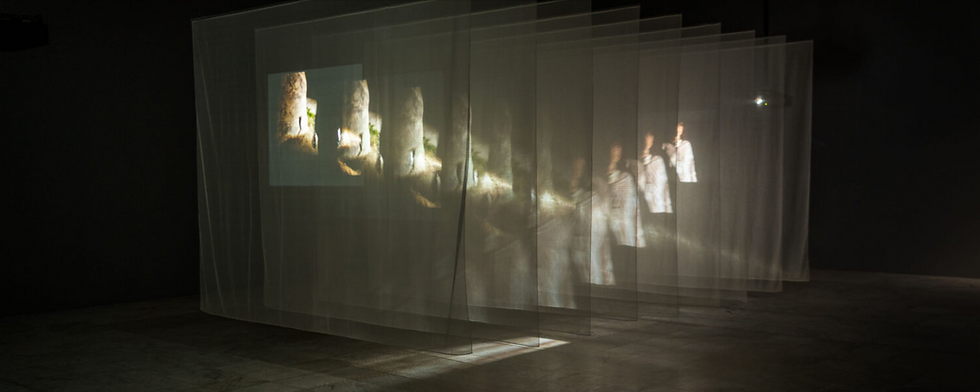
Rodrigo Valenzuela (b. 1982, Santiago, Chile) is a Chilean-born, Los Angeles–based artist whose practice interrogates labour, displacement, constructed space, and political subjectivity. Trained in photography and social documentary traditions, his work operates between staged photography, sculpture, installation, and drawing. Rather than treating photography as a tool for passive documentation, Valenzuela constructs environments that reveal how space itself is ideological.
Rodrigo Valenzuela's Sense of Place repositions landscape as a politically charged and ideologically unstable field rather than a neutral depiction of geography. In an interview conducted by Anna Furman for Hyperallergic, Valenzuela discusses Sense of Place and reflects on photographing desert environments such as Joshua Tree and the Atacama Desert. He describes the Atacama as "heavy", not only because of its physical altitude, but because "there are bodies buried there" from the Pinochet dictatorship. The landscape is therefore not empty; it holds historical violence, unresolved memory, and contested ownership.
In the interview, Valenzuela critiques the Western tradition of landscape painting, stating: "Most of the romantic paintings we encounter from the 19th century, for example by J.M.W. Turner and John Singleton Copley, contain a Western mentality of conquering nature and a sense of entitlement to land ownership". He contrasts this with his own experience as a migrant and day laborer, stating: "We day laborers work on the land, but we do not own the land". Place, in this formulation, becomes a site of labour without possession, belonging without security.
The material process of Sense of Place reinforces this conceptual position. Valenzuela explains that he photographs landscapes on black-and-white film, reproduces them via photocopy, and creates image transfers onto canvas. He explicitly describes the transfer method as "a metaphor for bureaucracy". During this process, he removes layers "with my fingers and a toothbrush and some sponges, so that only some of the toner makes its way into the canvas". The image becomes partial, abraded, and incomplete. The physical labour of producing the image parallels instability; it enacts incomplete access and negotiated visibility. Abstract linear overlays further complicate the landscape. These marks suggest "houses, governmental offices, and memorial structures yet to be built". They project possibility while withholding fulfilment. Valenzuela notes that he enjoys "projecting possibilities" while "still leaving the lines abstract," effectively "cutting the dream short" and leaving "the picture up to interpretation". The image remains unresolved.
This deliberate suspension aligns conceptually with 無 Mu / Between Footsteps. In my project, photographs are made in the interval between movement and arrival, where certainty collapses and meaning are withheld. Valenzuela similarly sustains ambiguity.
In summary, Sense of Place demonstrates how environment can be constructed as an unstable ideological field through process, abstraction, and refusal of closure. In relation to 無 Mu / Between Footsteps, Valenzuela’s project reinforces the potential of incomplete image transfer, suspended meaning, and layered materiality to articulate psychological and political negotiation. Both bodies of work position place as unresolved terrain, where identity and belonging remain provisional.


References:
Furman, A. 2017, ‘Rodrigo Valenzuela’s Sense of Place’, Hyperallergic, viewed 1 March 2026, <https://hyperallergic.com/rodrigo-valenzuela-sense-of-place>.
Valenzuela, R. n.d., Rodrigo Valenzuela, viewed 1 March 2026, <https://www.rodrigovalenzuela.com/>. (Figures 1-16)