

T4 WK 2 - RESEARCH
- Feb 21
- 3 min read
Updated: Apr 8
The Symbolism of the Noren | Curtain to Spatial Concept in Mu 無 / Between Footsteps
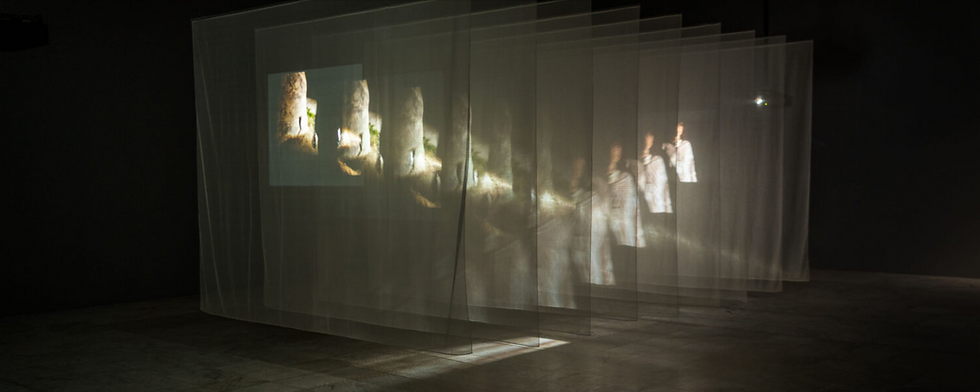
This research examines the symbolism of the Japanese Noren (暖簾) and considers how its underlying meanings can inform the development of an installation for Mu / Between Footsteps. Rather than adopting the Noren as a literal curtain, I investigate it as a conceptual and spatial framework. The Noren is understood as a marker of transition, a membrane between states, and a structure that activates the body through passage. Its symbolic language provides a way to expand my project beyond representation and into embodied encounter.
The Noren emerged during the Edo period as a textile hung at entrances of homes and shops. While practical in function, it gradually acquired symbolic meaning. It signified that a business was open, represented family identity through crests, and stood for continuity and reputation. The phrase "to protect the Noren" came to mean preserving honour and legacy.
Symbolically, the Noren does not close space; it filters it. It divides interior and exterior without solid separation. The vertical split allows entry but makes that entry visible and intentional. One must physically part it. The Noren therefore represents a condition of in-between — neither fully outside nor fully inside. It marks a threshold rather than a barrier.
In spiritual contexts, textile thresholds also define sacred transition. Passing beneath fabric can signify movement from ordinary to altered space. The act of crossing becomes conscious and physical.

Mu / Between Footsteps investigates instability through walking, fatigue, and suspended perception. Photographs are produced in the interval between steps. Moments where movement has begun but arrival has not occurred. These images are translated into cyanotype on textile substrates, maintaining tonal restraint and resisting finality.
The symbolism of the Noren provides a structural extension of this inquiry. Rather than functioning as a literal doorway curtain, it informs the development of installation as membrane. The work becomes a spatial threshold that viewers must navigate. Movement activates fragmentation. The image is no longer fixed against a wall but could be suspended within a field of passage.
Several symbolic dimensions of the Noren directly reinforce the conceptual foundation of the project. First, it allows light and people to pass through it, but never completely clearly. This is similar to cyanotype, where the image is partly revealed and partly hidden by light. Second, you have to physically move it to pass through. That action reflects the effort and adjustment involved in walking, especially when movement is difficult or strained. Third, while the Noren represents protection and long-lasting tradition, it is still just fabric and can wear down over time. This contrast between strength and softness reflects the tension in the body between endurance and vulnerability.

Rather than recreating a traditional doorway curtain, I propose translating the symbolism of the Noren into spatial installation principles:
A suspended membrane that must be navigated rather than simply viewed.
Multiple vertical divisions that fragment the image across space.
Light passing through material to create shifting shadows and secondary images.
Movement that destabilises perception.
The installation becomes a threshold environment. The viewer’s body activates it. The photograph is not presented as a static surface but as something interrupted and reconfigured through passage.


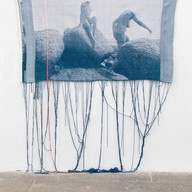


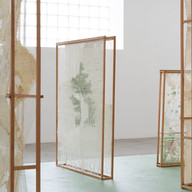

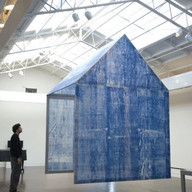




Figures 4-29Visual References (images sourced via Pinterest for visual research only. Creators unknown.
References:
iKimono 2024, The Art of Noren: Blending Japanese Tradition with Contemporary Style, iKimono Japan Blog, viewed 22 February 2026, <https://ikimono.co.nz/iKimono-Japan-Blog/The-Art-of-Noren-Blending-Japanese-Tradition-with-Contemporary-Style>. (Figure 3)
.
Kyoto Kogei Art Museum 2023, The history and cultural significance of Noren, Kyoto Kogei Art Museum, viewed 22 February 2026, <https://kogeiart.kyoto.jp/articles/post-1805/>. (Figure 2)
Pinterest n.d., Pinterest, website, viewed 22 February 2026, <https://au.pinterest.com/>. (Figures 4-29)
.
Stavanger Kunstmuseum 2023, Bill Viola, Stavanger Kunstmuseum, viewed 22 February 2026, <https://www.stavangerkunstmuseum.no/en/events/bill-viola-1>. (Figure 1)


