T4 ARTIST CASE STUDY: Meghann Riepenhoff
- Mar 7
- 6 min read
Updated: Apr 8

Meghann Riepenhoff is a contemporary artist whose work expands the possibilities of photographic practice through the use of cyanotype and direct environmental exposure. Her work sits between photography, printmaking, and environmental art, investigating relationships between landscape, time, material processes, and chance. Rather than using cyanotype as a conventional photographic printing technique, Riepenhoff works outdoors, placing large sheets of light-sensitive paper directly within natural environments such as oceans, rivers, snow, and rain. In doing so, she allows the environment to actively participate in the formation of the image. The resulting works are not simply photographs of nature but physical records of an encounter between photographic material and the forces of the landscape.
Riepenhoff repositions this early photographic technique within contemporary practice by removing it from controlled studio conditions and exposing it directly to environmental forces. Instead of placing photographic negatives onto prepared paper, Riepenhoff works with large sheets of coated paper that are exposed to sunlight while simultaneously interacting with elements such as waves, currents, rainfall, or snow. Water may partially wash away the chemicals, sand or sediment may stain the surface, and the movement of tides may distort the exposure. These interactions introduce a degree of unpredictability into the image-making process. As a result, the landscape itself becomes a collaborator in the creation of the work. The final image emerges through a negotiation between the artist’s preparation of the material and the actions of the environment.
One of Riepenhoff’s most recognised bodies of work is the ongoing series Littoral Drift. The term “littoral drift” refers to the geological movement of sediment along a coastline through wave action. Riepenhoff adapts this concept to describe the process of placing long strips of cyanotype paper directly within the surf. During the exposure, the paper is anchored or held at the water’s edge while waves wash across its surface. Sunlight activates the light-sensitive chemicals while the ocean simultaneously develops, stains, and disrupts the image. Saltwater, foam, sand, and tidal motion leave traces across the surface of the print.
.
The resulting works often appear as large horizontal compositions, diptychs or triptychs that visually echo the horizon line of the sea. Rather than depicting a recognisable landscape, the cyanotypes record the physical behaviour of the water itself. Marks produced by waves and currents create patterns of movement across the surface of the paper, transforming the photograph into a trace of environmental activity. Each print records a specific interaction between sunlight, water, and time, meaning that no two works can be replicated.
Another important body of work within Riepenhoff’s practice is the series Ecotone. In ecology, an ecotone refers to a transitional zone between two ecosystems, such as the boundary between land and water. In this project, Riepenhoff explores environments where natural conditions intersect and transform. Cyanotype papers are exposed during rainstorms, snowfall, or within shifting tidal zones, allowing atmospheric conditions to shape the image. Rainwater produces droplets and stains across the surface, while snow and melting ice generate subtle tonal variations within the blue field of the cyanotype.
Through these processes, the images become records of environmental activity rather than representations of a specific place. The works operate as both photographs and material documents of natural events. They emphasise duration and change rather than the frozen moment traditionally associated with photography. Instead of capturing a single instant, the cyanotypes accumulate marks over time as environmental forces repeatedly interact with the paper.
Riepenhoff’s practice reflects broader developments in contemporary photography, where artists increasingly explore expanded approaches to the photographic medium. By exposing photographic materials directly within natural environments, she challenges traditional ideas of authorship and control. The artist initiates the process by preparing the paper and placing it within the landscape, but the final image emerges through the unpredictable interaction between sunlight, water, and atmospheric conditions. In this way, the works question the assumption that photographs are purely human-made representations and instead frame them as records of collaboration between artist and environment.
Her cyanotypes also expand photography into the space of installation. The prints are often displayed in large formats or in sequences that emphasise their physical scale and material presence. Rather than functioning solely as framed images, they operate as objects that carry traces of their environmental exposure. Salt, sand, water marks, and irregular edges remain visible on the surface of the paper, reinforcing the idea that the work documents a physical event rather than simply depicting a scene.
Riepenhoff’s approach demonstrates how historical photographic processes can be reinterpreted within contemporary practice. By removing cyanotype from the studio and allowing environmental forces to shape the image, she transforms the technique from a method of reproduction into a form of environmental recording. The works reveal how photographic materials can act as sensitive surfaces that respond to natural conditions, capturing movement, duration, and transformation.

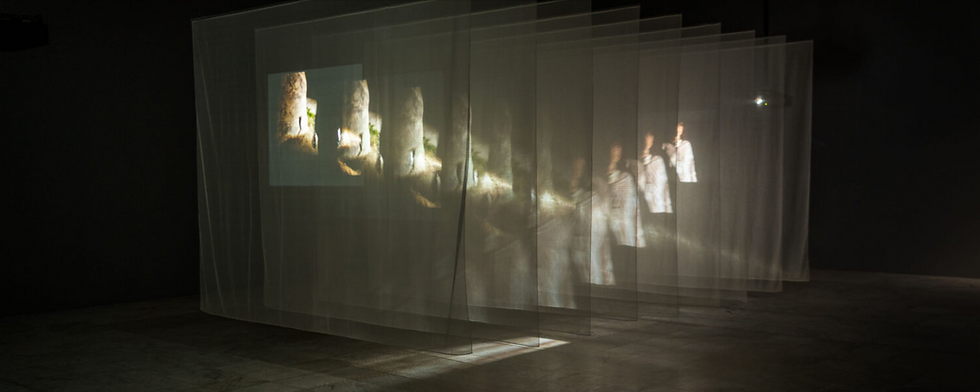
Riepenhoff’s work offers significant guidance and inspiration for my own practice, particularly in relation to cyanotype experimentation and process-based image making. In my work, cyanotype functions as a foundation image that becomes the ground for further intervention through drawing, painting, or installation. Her practice reinforces the idea that the photographic surface can operate as a site of transformation rather than a final image. By allowing environmental conditions to shape the work, she demonstrates how unpredictability and chance can become integral parts of the artistic process.
Her approach also aligns with my interest in instability and uncertainty within image-making. The unpredictability of waves, rain, and other environmental forces introduces disruption into the surface of the print, creating marks that cannot be entirely controlled by the artist. This willingness to accept uncertainty provides a useful precedent for incorporating instability and interruption within my own work, particularly when exploring the concept of "mu" and the idea of images existing within a space of uncertainty.
Finally, Riepenhoff’s large-scale presentation of cyanotype prints offers a model for expanding photography into installation and spatial experience. Her work demonstrates how photographic images can extend beyond traditional framing to become immersive environments that viewers physically encounter. This approach resonates with my own intention to develop suspended photographic installations that viewers move through or around or are overwhelmed with their size. For these reasons, Meghann Riepenhoff’s practice provides both conceptual and technical inspiration, demonstrating how cyanotype can function as a method for recording environmental interaction, movement, and the passage of time.


References:
LensCulture 2018, Meghann Riepenhoff: Littoral Drift, LensCulture, viewed 7 March 2026, <https://www.lensculture.com/articles/meghann-riepenhoff-littoral-drift>. (Figures 1-8)
Photographic Center Northwest (2020), Meghann Riepenhoff talks about her series “Littoral Drift”, video, Vimeo, viewed 7 March 2026, <https://vimeo.com/466639440>. (Video 2)
Riepenhoff, M 2026, Ecotone, viewed 7 March 2026, <https://meghannriepenhoff.com/project/ecotone/>.
Riepenhoff, M 2026, Littoral Drift, viewed 7 March 2026, <https://meghannriepenhoff.com/project/littoral-drift/>.
Riepenhoff, M 2023, Meghann Riepenhoff | Video for 555 Greenwich “Littoral Drift” Commission, video, Vimeo, Yossi Milo Gallery, viewed 7 March 2026, <https://vimeo.com/888261744/59b7c3fae7>. (Video 1)