T4 WK 1 - PERSONAL REFLECTION & INITIAL RESEARCH DIRECTION
- Feb 14
- 3 min read
Updated: Jun 4

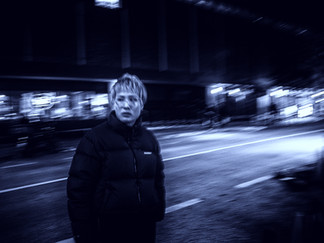
My practice begins from a body that does not move seamlessly through space. Walking is negotiated through pain, imbalance, and interruption. Because of this, photography is not an act of capture but an act of timing. Photographs are made between steps, in the interval where stability has not yet been regained. These fragments resist clarity. They exist within the Zen thought of mu (無), a condition where meaning is not fixed and certainty is suspended.
Photography for me is already unstable. It is partial, provisional, and unresolved. What I am now interested in is how that instability can be materially amplified rather than conceptually implied.
The starting proposal for my Major Project is to create multiple photographic cyanotype prints on hessian, overlaid with a fluorescent grid. From a distance, the surface will appear abstract and structured. Only through proximity will photographic details emerge. The viewer will have to move toward the work to access it, mirroring the bodily negotiation embedded in its making. However, I also want to introduce another Japanese spatial reference: the noren.
In Japan, noren are fabric curtains traditionally hung across doorways of homes, shops, temples, and bathhouses. They serve practical purposes — dividing interior and exterior, filtering light and air, and indicating whether a business is open. However, they also function symbolically. Noren mark thresholds. They create semi-permeable boundaries between public and private space. Historically, they have also been associated with protection — acting as barriers against dust, impurity, and, within Shinto cosmology, spiritual contamination. The threshold is not neutral; it is charged.
This resonates deeply with my work. The cyanotype surface becomes a threshold between movement and stillness. The fluorescent grid becomes a barrier. Introducing curtain-like qualities would reinforce the idea of privacy, concealment, and protection. A hanging hessian cyanotype could function like a noren: partially obscuring, partially revealing. Viewers would need to move around or through it, physically engaging the idea of passage and transition.
New Tools, Materials, and Media to Explore
To extend my current practice, I want to investigate:
Cyanotype at large scale, particularly on absorbent and unstable materials such as hessian.
Industrial fluorescent pigments to construct a rigid grid that competes visually with the photographic surface.
Hanging cyanotype panels that behave like curtains rather than flat paintings.
Soft, weighted fabric edges that reference noren splits down the centre.
Material vulnerability, allowing the hessian to fray, sag, or shift, reinforcing instability.
Spatial installation, potentially suspending works so they move slightly with air, echoing imbalance.
These experiments shift my work from image-based presentation to spatial encounter. The emphasis moves from representation to physical negotiation.
Developing the Research Question
According to the recommended framework, a research question should be focused, researchable through practice, and clearly aligned with materials and method. It must identify the relationship between concept and process.
How does the imposition of a fluorescent grid over cyanotype photographs made during unstable movement reframe the photographic image as a field of constraint and resistance?
or
How can large-scale cyanotype on hessian, structured by fluorescent grids and installed as curtain-like thresholds, materialise the tension between bodily instability, protection, and the philosophical condition of mu?
This question is practice-led. It identifies medium, method, and conceptual tension. It allows investigation through material testing rather than theoretical abstraction alone.
Direction for the Major Project
The project will examine whether structure suppresses or intensifies instability. The grid may act as containment, echoing physical limitation, yet it may also activate the image beneath it. The cyanotype surface will hold moments made in uncertainty. The grid will attempt to fix them.
The research outcome will not aim for resolution. Instead, it will test how tension can be sustained visually and materially.