

INDUSTRY: Ingrid Hedgecock talks about her career in the arts sector
- Apr 29
- 4 min read
Updated: May 20
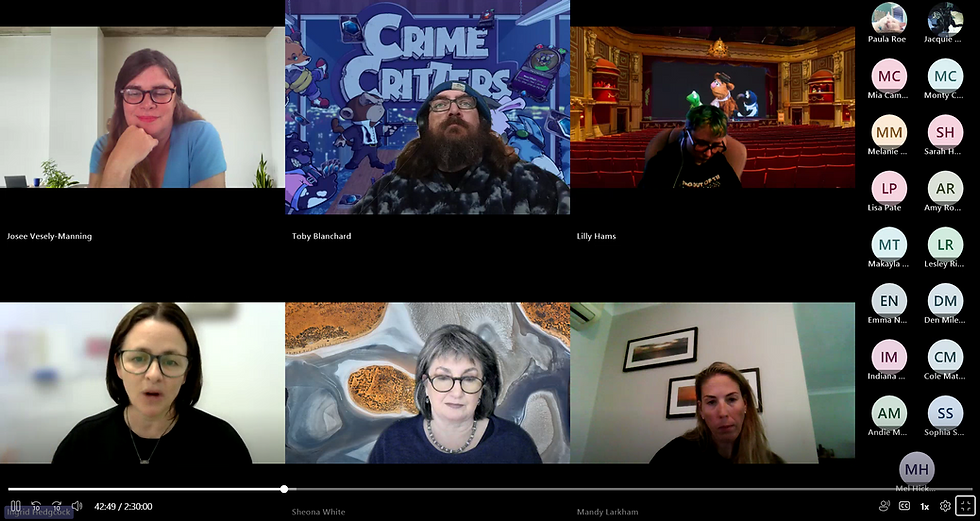
The guest lecture by Ingrid Hedgecock examines the role of regional galleries within the Australian arts sector through discussions of curatorial practice, administration, funding, artist development, and cultural tourism. Rather than presenting gallery work through institutional status, Hedgecock outlines the structural and operational conditions that shape gallery leadership. She positions the regional gallery as a site operating between public engagement, economic accountability, cultural policy, and artist support.
One of the central discussions within the lecture is the absence of a fixed pathway into arts leadership. Hedgecock states that when beginning university, she did not know what a curator was or that such a role would become part of her career. This statement challenges assumptions surrounding professional direction within the arts and instead frames career development as a process shaped through experience, experimentation, and institutional engagement. Her progression from volunteer at the Brett Whiteley Studio to Director of the Tweed Regional Gallery and Margaret Olley Art Centre demonstrates how arts careers often emerge through participation within multiple sectors of the industry rather than through predetermined trajectories.
Hedgecock also discusses the shift from curatorial work into gallery leadership. She explains that while her previous role focused on the world and archive of Margaret Olley, the directorial role requires engagement across all operational aspects of the institution. Funding becomes a central concern. Hedgecock identifies fundraising, grant applications, sponsorship, and budgeting as continuous responsibilities within gallery administration. This discussion reveals that gallery leadership extends beyond exhibition programming and requires negotiation with economic structures that determine institutional sustainability.
The lecture further examines the relationship between galleries and regional economies. Reference is made to an economic impact study demonstrating the contribution of the gallery to tourism and commercial activity within the Tweed region. Hedgecock explains that visitors attending the gallery also contribute to accommodation, retail, hospitality, and other sectors within the region. However, she resists reducing the gallery to an economic instrument alone. Alongside economic contribution, she identifies belonging, social cohesion, and community participation as forms of cultural impact that cannot be measured solely through financial data.
Another major focus of the lecture is artist development through exhibitions, mentorship, and residencies. Hedgecock outlines how the Platform Program supports artists from the surrounding region through application-based opportunities and curatorial guidance. She describes the program as a form of mentorship in which artists work closely with gallery staff through the development and presentation of exhibitions. This positions the gallery as a site of professional development rather than solely a site of display.
The Nancy Fairfax Artist in Residence Studio is discussed as a model that prioritises time, concentration, and process within artistic practice. Hedgecock explains that the residency space was developed alongside the Margaret Olley Arts Centre and functions as both studio and accommodation. The residency supports artists through either self-funded or invitation-based models. Importantly, Hedgecock emphasises that the residency does not require production outcomes for self-funded participants. Instead, it provides conditions for artists to focus on conceptual development, experimentation, observation, or research.
This emphasis on process becomes central in the discussion of artist Kirsten Coelho’s residency. Hedgecock explains that Coelho used the residency primarily for observation, documentation, and research rather than material production. Activities such as measuring, photographing, note-taking, and studying light formed part of her process before returning to the studio to produce ceramic works. This challenges productivity-based assumptions surrounding artistic labour by recognising thinking, observation, and research as components of artistic practice.
The lecture also examines curatorial approaches centred on process and artistic environments. Hedgecock discusses her experience working with preserved studio spaces, particularly through the Margaret Olley Arts Centre. The recreation of Margaret Olley’s home studio is framed not simply as archival reconstruction but as a way of presenting artistic process alongside finished works. This approach positions the gallery as a space where audiences encounter artistic labour, material culture, and systems of making rather than isolated artworks alone.
Reflecting on the lecture, I found Hedgecock’s discussion useful because it provided insight into galleries operating beyond exhibition display. Hedgecock demonstrates that regional galleries contribute to tourism, education, artist development, and community participation while also functioning within economic and policy frameworks. This challenged assumptions that cultural significance is concentrated within metropolitan institutions and instead positioned regional galleries as sites of cultural production, exchange, and support. Her discussion of residencies and process-based practice also connected with my own interests in research-led and process-oriented approaches to artmaking. The idea that observation, collection, documentation, and reflection form part of artistic production aligns with how I approach practice-based work.


References:
Hedgecock, I 2026, Guest lecture presented for Entrepreneurship and Innovation in Creative Industry via Microsoft Teams, Newcastle Art School, viewed 29 April 2026. (Figure 1)
Tweed Regional Gallery & Margaret Olley Art Centre n.d., Tweed Regional Gallery & Margaret Olley Art Centre, viewed 15 May 2026, <https://gallery.tweed.nsw.gov.au>. (Figures 2-4)


