

INDUSTRY: analysis and reflection of Guest Lecture, Sebastian Henry-Jones – artist, curator and business owner
- Mar 24
- 6 min read

(Adapted from Assessment 3) Sebastian Henry-Jones' guest lecture presents a critically considered redefinition of contemporary curatorial practice, one that actively displaces institutional authority in favour of collectively produced and context-responsive cultural engagement. Through a combination of project-based examples and discussion with students, he presents a curatorial practice informed by do-it-yourself ethics, relational accountability, and an expanded understanding of culture as something that exists beyond institutional systems. This reflection evaluates his position as both an ideological critique and a practical way of working, while situating these insights within the context of my own curatorial practice and organisational work through The Pictorial List and Pictorial Foundation.
At the centre of Henry-Jones' lecture is a decisive challenge to the assumption that institutions are the primary sites of cultural production. He asserts that his most significant cultural experiences have occurred outside galleries, reframing culture as something that is already active within everyday life rather than something that requires institutional validation. His use of the meme as a curatorial format identifies a form of cultural production that is accessible and highly responsive yet remains largely unrecognised within institutional systems. In doing so, he exposes what can be understood as an epistemic lag, where institutions are structurally unable to engage with emergent cultural forms in real time.


This critique is further intensified through his discussion of the Wayside Chapel, which he positions as a site of continuous and relational cultural production. By identifying everyday interactions within the op shop as more culturally significant than major exhibitions such as the Biennale of Sydney, Henry-Jones collapses the distinction between art and life, reframing culture as something enacted through social relationships rather than curated into visibility. The implication for curatorial practice is far-reaching. The curator is no longer positioned as an authoritative selector of objects, but as a facilitator, participant, or mediator within existing cultural ecosystems.

The conversational structure of the lecture reinforces the significance of this repositioning. A student’s observation around “prioritising your actual mob” articulates a key ethical dimension of Henry-Jones’ approach. This is demonstrated in his reflection on presenting Gabi Briggs’ work within her own community in Armidale rather than solely within an institutional space. While the institutional iteration provided professional visibility, he identifies the community-based presentation as more meaningful due to its direct engagement with cultural specificity and audience relevance. This distinction foregrounds a critical tension between visibility and accountability, suggesting that curatorial success should be measured not by institutional recognition but by the depth of its relational impact.
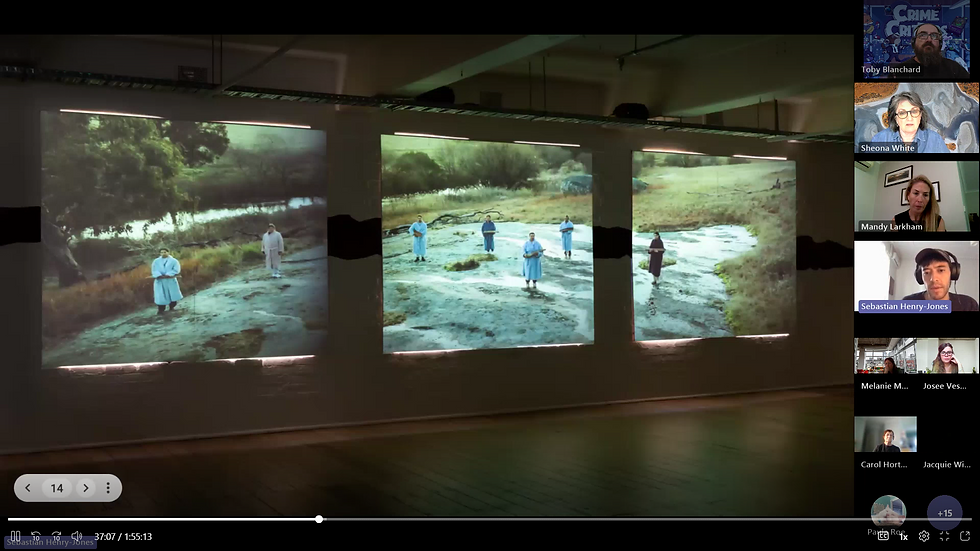
Henry-Jones' emphasis on DIY practice operates as both a realistic response to structural limitations and a deliberate conceptual position. His example of staging an exhibition within a car park demonstrates how alternative infrastructures can be constructed outside institutional systems, producing dynamic and socially engaged cultural experiences. In response to student engagement, he frames DIY practice as a form of empowerment, highlighting the capacity for collective action to generate cultural production without reliance on institutional permission. This decentralised model of practice redistributes agency and challenges traditional hierarchies within the arts sector.

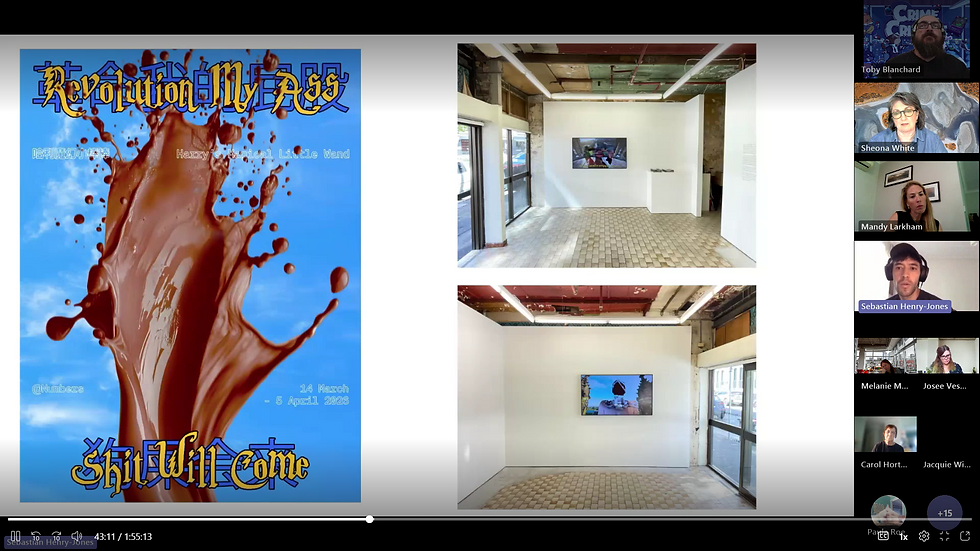
However, the lecture does not romanticise independence. Henry-Jones' transparency regarding the financial and logistical realities of running Numbers Gallery introduces a critical layer of complexity. The reliance on fundraising, shared financial responsibility, and informal economies underscores the precarious nature of independent practice. A student's inquiry into the funding structures further reveals the constraints imposed by grant systems, particularly their requirement for predetermined programming and measurable outcomes. Henry-Jones' interest in "breaking the rules" after securing funding reflects a strategic awareness of these limitations, while also raising questions around sustainability and ethical engagement with institutional frameworks.
This tension between autonomy and sustainability is particularly relevant within my own organisational context. Through The Pictorial List and Pictorial Foundation, there is a similar negotiation between maintaining curatorial integrity and engaging with funding structures that often require fixed outcomes and measurable impact. Henry-Jones’ approach suggests that while institutions can provide necessary resources, they must be navigated critically, with an awareness of how they shape both content and process. At the same time, his model reinforces the value of developing alternative economies and community-supported initiatives.
A significant strength of Henry-Jones' practice lies in its emphasis on values-driven collaboration. In discussing the formation of artist-run initiatives, he prioritises the establishment of shared principles before the development of programming. This suggests that curatorial practice operates as a form of social structuring, where the conditions of collaboration are as significant as the outcomes produced. This approach aligns closely with my own curatorial strategies within projects such as CODE GIRL and Women in Public Space, where the focus is not only on the final exhibition but on creating pathways that support inclusivity and long-term engagement for artists.
Henry-Jones' reflections on education and professional development further complicate traditional narratives of expertise. Despite his formal training in curating, he positions experiential learning as the primary driver of his practice, suggesting that much of what he studied holds limited relevance to his current work. Instead, his approach is informed by broader theoretical perspectives, including sociology and economic philosophy, as well as by practical experimentation. This reinforces the importance of practice-led learning, where knowledge is generated through experimentation, action, reflection, and iteration.
From a career perspective, Henry-Jones presents a model that is both adaptive and strategically positioned within the realities of the contemporary arts sector. His portfolio-based approach, spanning teaching, freelance curating, writing, and community work, reflects a non-linear trajectory that requires constant negotiation of time, labour, and resources. His acknowledgment of burnout, prompted by my question on time management, highlights the risks associated with sustaining such a practice. This complicates the empowerment often associated with DIY culture, foregrounding the need for sustainable models of practice that can support long-term creative and personal wellbeing.
For my own career development, this lecture reinforces the importance of balancing independence with structural support. While DIY and community-driven initiatives allow for greater flexibility and responsiveness, they must be underpinned by sustainable frameworks that recognise the value of artistic labour. This is particularly relevant in my ongoing objective to develop funding models within Pictorial Foundation that prioritise artist fees and equitable opportunities, challenging the widespread undervaluation of creative work.
Critically, Henry-Jones' lecture prompts a reconsideration of how success is defined within the arts. Rather than aligning success with institutional recognition or career advancement, he foregrounds relevance, impact, and relational engagement as primary measures of value. This reframing, challenges dominant industry narratives and aligns with my own curatorial vision, which seeks to position visual storytelling as a platform for shared experience and dialogue rather than as an aesthetic or commercial enterprise.
In conclusion, Sebastian Henry-Jones offers a critically engaged and multifaceted model of curatorial practice that expands the boundaries of the field. By prioritising context, community, and collective agency, he challenges conventional assumptions about where culture happens and how it should be supported. At the same time, his reflections reveal the structural and personal challenges of sustaining such a practice, particularly in relation to funding and labour. For my own practice, the lecture provides both encouragement and critical insight, reinforcing the importance of developing a curatorial approach that is not only conceptually critical but also socially responsive and sustainably structured.
References: Henry-Jones, S 2026, Guest lecture presented via Microsoft Teams for Entrepreneurship and Innovation in Creative Industry, viewed 25 March 2026.


