

EXCURSION TO 25TH BIENNALE OF SYDNEY
- Mar 24
- 3 min read

Attendance at the Biennale of Sydney as part of a Newcastle Art School excursion provided insight into the scale and complexity of contemporary international exhibition practice. Travelling from Newcastle to Sydney as a group, we visited both the Art Gallery of New South Wales and White Bay Power Station, two exhibition sites operating within the Biennale program. Experiencing these contrasting spaces demonstrated how contemporary curatorial practice can extend beyond conventional gallery settings through installation, moving image, sound, and immersive spatial design. This reflection has been adapted from Assessment 3.
The Art Gallery of NSW offered a more traditional 'white box' institutional viewing experience, while White Bay transformed an industrial site through large-scale interdisciplinary installations. The contrast between these venues highlighted how curatorial decisions and spatial context influence the way audiences engage with contemporary art. The installations at White Bay particularly revealed the level of coordination required between artists, curators, technicians, and funding bodies to realise ambitious projects. Observing these works expanded my understanding of the logistical, material, and financial structures supporting contemporary exhibition-making.
The experience was highly motivating and reinforced the potential of large-scale installation practice within contemporary art.


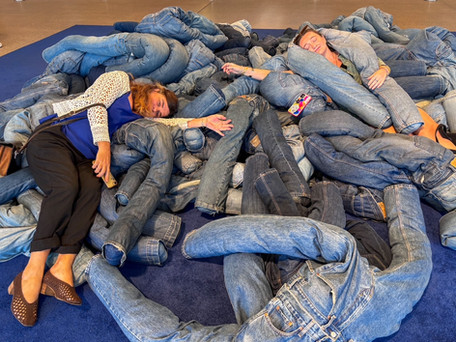


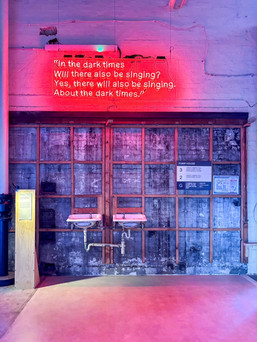

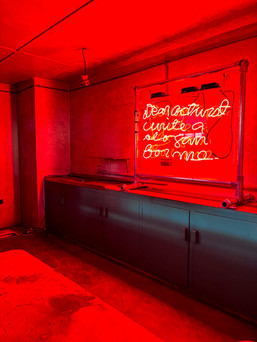

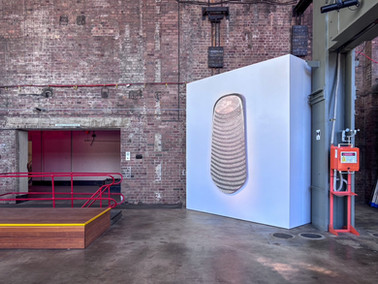






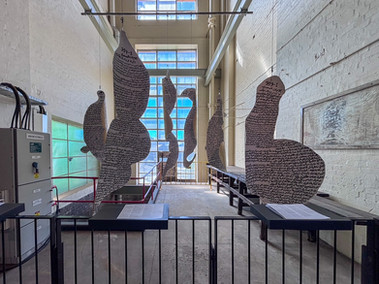




Nikesha Breeze’s Living Histories (2026), presented at the 25th Biennale of Sydney 2026, operates as an immersive installation that combines cyanotype, suspended textiles, sound, projection, performance, and sculptural environments to investigate memory, ancestral knowledge, and archival reclamation. Installed within White Bay Power Station, the work draws from Born in Slavery: Slave Narratives from the Federal Writers’ Project, a digital archive containing over 2,300 testimonies from formerly enslaved African Americans. Breeze transforms these historical records into a multisensory environment where memory is not presented as static documentation, but as something embodied, spatial, and continually activated through movement and encounter.
Central to the installation are monumental Baobab-inspired textile forms constructed from raw cotton gauze and materials historically tied to plantation economies. These suspended structures function simultaneously as sculpture, architecture, and symbolic threshold. Rather than separating image, sound, and object into distinct disciplines, Breeze collapses these boundaries, allowing the installation to operate as a relational system in which viewers physically move through layers of projected imagery, sound, fabric, and shadow. Cyanotype prints appear within this environment not as isolated photographic works but as material fragments embedded within a larger spatial and historical framework.
Breeze repositions archival material within a living and unstable environment, where testimony becomes activated through bodily encounter and sensory experience. The work refuses passive viewing. Instead, viewers are required to navigate through suspended forms and fluctuating light conditions, producing an embodied relationship to memory and absence. The installation therefore operates less as representation and more as a site of transmission, where histories continue to resonate physically and emotionally within the present.
Breeze’s integration of cyanotype is particularly significant within the context of my own project, Beyond Footsteps. Her use of cyanotype extends beyond photographic reproduction and instead positions the process as a material carrier of memory, fragility, and temporality. This has influenced my understanding of cyanotype as something spatial and experiential rather than image-based alone. In my own work, cyanotype operates similarly as a material process shaped by exposure, instability, and environmental conditions, where uneven tonal shifts and translucency become conceptually important rather than technical flaws.
Breeze’s installation demonstrates how contemporary photography can move beyond the framed image and operate relationally through installation, sound, materiality, and bodily encounter. This has encouraged me to think critically about how my cyanotype works can function not simply as photographs, but as spatial systems that hold interruption, instability, and lived experience. Through this, Living Histories has become an important reference point for expanding my practice beyond traditional photographic presentation and toward a more immersive and materially contingent installation language.





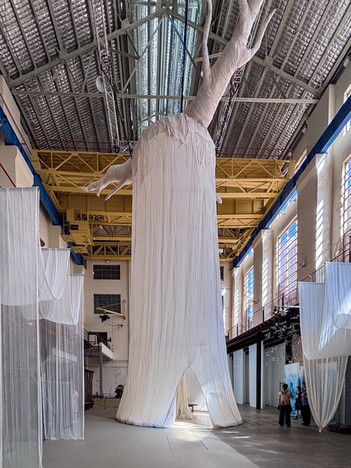

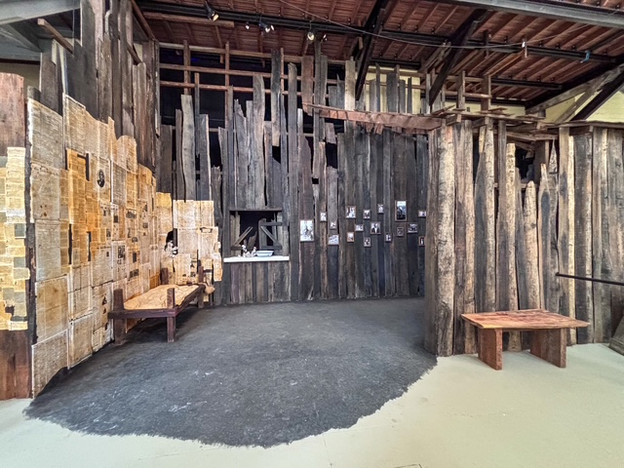



Figures 18-29. Nikesha Breeze, Living Histories (2026)
References:
Art Gallery of New South Wales 2026, 25th Biennale of Sydney, Art Gallery of NSW, viewed 24 March 2026, <https://www.artgallery.nsw.gov.au/whats-on/exhibitions/25th-biennale-of-sydney>.
Biennale of Sydney 2026, Biennale of Sydney, viewed 24 March 2026, <https://www.biennaleofsydney.art>.
Breeze, N 2026, Living Histories, viewed 24 March 2026, <https://nikeshabreeze.com/living-histories>.
Meggs, M 2026, Documentation of installation at Art Gallery of New South Wales during the Biennale of Sydney excursion, digital photograph, personal collection. (Figures 1-3)
Meggs, M 2026, Documentation of installation at White Bay Power Station during the Biennale of Sydney excursion, digital photograph, personal collection. (Figures 4-29)


