

INDUSTRY WK 7: Case Studies - explore, compare and discuss the career trajectories of 3 artists
- Mar 24
- 4 min read

The careers of Jadé Fadojutimi, Amoako Boafo and Refik Anadol reflect distinct pathways within contemporary art, shaped by medium, networks, and institutional alignment.
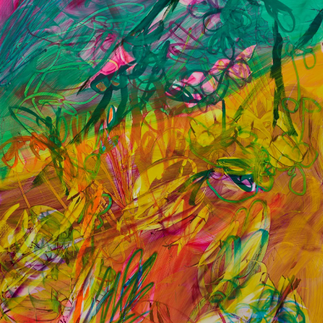
Jadé Fadojutimi (b. 1993, London) produces large-scale abstract paintings that explore emotion, memory, and internal states. Her practice is process-driven, built through layers of colour, gesture, and mark-making that evolve over time. Working intuitively, she allows each element to respond to the last, creating compositions that remain open and unresolved. Rather than depicting specific subjects, her work translates personal experience into rhythm, movement, and spatial relationships. Scale plays a key role, requiring physical engagement with the canvas. Her practice positions painting as a way of thinking, where meaning is not fixed but continuously shifting through process and perception.
Fadojutimi’s career trajectory reflects a rapid rise within contemporary painting, shaped by early institutional recognition and strong gallery representation. She studied at the Slade School of Fine Art in London, where her large-scale abstract works developed through an engagement with emotion and memory. Her paintings quickly gained attention for their scale, colour, and gestural intensity, aligning with a renewed interest in abstraction. Soon after graduating, she was represented by major international galleries, accelerating her visibility. Early solo exhibitions and inclusion in significant group shows positioned her within global art circuits, while her work entered important collections at an early stage.



Amoako Boafo's (b. 1984, Accra) art practice focuses on portraiture to explore identity, representation, and visibility. His work centres on Black figures, often from his community, presented with directness and presence. He is known for using finger painting to depict skin, creating textured surfaces that emphasise individuality and the act of making. Figures are often placed against simplified backgrounds, drawing attention to posture and gaze. His practice addresses the historical absence and misrepresentation of Black bodies in art, using portraiture as both a personal and political act that asserts presence through material and form.
Boafo trained at the Ghanatta College of Art and Design in Accra before continuing at the Academy of Fine Arts in Vienna, positioning his practice within a European context while maintaining a focus on Black identity and representation. In 2018, artist Kehinde Wiley discovered Boafo's Instagram page, and bought a work from him as well as sending his work on to his own gallerists. This introduction led to a solo show of Boafo's work at Roberts Projects in Los Angeles. Since then, his work has generated considerable international buzz.
Boafo trajectory demonstrates how strong visual identity, cultural relevance, and strategic support can rapidly move an artist from emerging to established.


Refik Anadol’s (b. 1985, Istanbul) art practice is centred on using data as a primary material. His process involves collecting data from sources such as images, archives, or environmental inputs, which are then processed through artificial intelligence systems. These systems analyse and transform the data into moving visual compositions, often presented as large-scale projections or immersive environments. Viewers are often surrounded by dynamic visuals that respond to data flows, creating a sense of being inside a living system.
Anadol began with a background in visual communication and media arts in Turkey before moving to Los Angeles to complete further study at UCLA. This transition placed him within a research-driven and technologically advanced environment, where he began exploring data as a primary artistic material. His early career gained attention through public installations that transformed architectural spaces using data-driven visuals. These works attracted institutional interest, leading to collaborations with major museums, galleries, and tech organisations. Anadol’s trajectory has been shaped by commissions, interdisciplinary partnerships, and access to technical infrastructure.
As his practice expanded, he established a studio that operates more like a lab, involving teams of engineers, designers, and researchers. This reflected a shift to collaborative production. His work has since been exhibited internationally, often in large-scale immersive environments that engage broad audiences.
Anadol’s new project, Dataland, brings together practitioners from art, science, AI research, and advanced technology under the direction of Refik Anadol Studio. Set to launch in Spring 2026 at The Grand LA in Downtown Los Angeles, the project positions itself within a major cultural precinct, aligning with established visual and performing arts institutions while expanding his exploration of data as an immersive artistic medium.

References:
Artnet 2026, Amoako Boafo, Artnet, viewed 28 March 2026, <https://www.artnet.com/artists/amoako-boafo>. (Figures 5-7)
Birmingham, L 2019, Studio Visit: African artist Amoako Boafo challenging the status quo, video, YouTube, viewed 28 March 2026, <https://youtu.be/XC7oDKjpx3o?si=iUBBO3Km8KmGALcy>. (Video 1)
Dataland 2026, Dataland, viewed 28 March 2026, <https://dataland.art>. (Figure 8)
Fadojutimi, J 2026, Jadé Fadojutimi, viewed 28 March 2026, <https://jadefadojutimi.com>. (Figures 2-4)
Gagosian 2026, Amoako Boafo, Gagosian Gallery, viewed 28 March 2026, <https://gagosian.com/artists/amoako-boafo>. Gagosian 2026, Jadé Fadojutimi, Gagosian Gallery, viewed 28 March 2026, <https://gagosian.com/artists/jade-fadojutimi>. (Figure 1)
Louisiana Channel 2023, AI Is an Extension of My Mind | Artist Refik Anadol, video, YouTube, viewed 28 March 2026, <https://youtu.be/S-39QKRNESc?si=Gj9509y-idssjRkS>. (Video 2)


