

INDUSTRY WK 8: funding, grants and residencies
- Apr 1
- 6 min read
Updated: May 13
Week 8 focused on the professional and strategic aspects of sustaining a creative practice through funding opportunities, grant applications, residencies, and project planning. The lecture, in class examples and readings highlighted that artistic practice does not operate independently from administration, budgeting, and communication. Instead, these systems are necessary to support the production, presentation, and long-term sustainability of creative work.
A major focus of the week was understanding project funding structures. This included learning how to develop realistic budgets, identify project costs, and clearly communicate the aims and outcomes of a project through concise written proposals and briefs. Budget planning was framed not simply as accounting, but as a way of demonstrating professionalism and feasibility. Learning to justify expenses, timelines, materials, travel, installation costs, and artist fees showed how financial planning directly shapes whether a project is considered viable by funding bodies.
The week also explored the importance of residencies as opportunities for artists to temporarily step outside everyday routines in order to experiment, research, and develop their practice. Residencies were discussed as spaces for reflection, networking, collaboration, and concentrated making. This shifted my understanding of residencies beyond travel opportunities, positioning them instead as critical environments for conceptual and professional growth.
One of the most valuable aspects of the week was researching grants and funding opportunities relevant to my own interdisciplinary and curatorial practice. This process revealed how important it is to align applications with the goals and language of funding organisations. Rather than applying broadly, successful applications require clarity, specificity, and a strong understanding of how a project connects to broader cultural, social, or community outcomes.
The week reinforced that artists today must often operate across multiple roles: artist, writer, administrator, curator, organiser, and project manager. While this can initially feel overwhelming, it also demonstrated that funding applications are not separate from creative practice. They are extensions of it, requiring artists to articulate why their work matters and how it can engage audiences meaningfully.

Art Almanac operates as a key informational resource within the Australian visual arts sector, documenting exhibitions, prizes, residencies, industry news, and professional opportunities. The platform highlights the interconnected nature of the contemporary arts industry by bringing together commercial galleries, artist-run initiatives, institutions, and independent projects within one accessible space. Its structure demonstrates how visibility and professional engagement are sustained through consistent participation in exhibitions, awards, and public programs. Art Almanac also reinforces the importance of industry awareness for emerging and established artists alike.

ArtsHub functions as a major industry platform connecting artists, organisations, and creative professionals with opportunities, news, funding, and professional development resources. The website reflects the fast-paced and highly competitive nature of contemporary creative industries, where artists must remain informed, adaptable, and professionally active. Its extensive listings of grants, residencies, jobs, and exhibitions demonstrate that sustaining an arts practice requires ongoing research, networking, and administrative engagement alongside creative production. ArtsHub also highlights the diversity of career pathways available within the arts sector, extending beyond traditional gallery systems into education, publishing, public programs, and interdisciplinary practice.
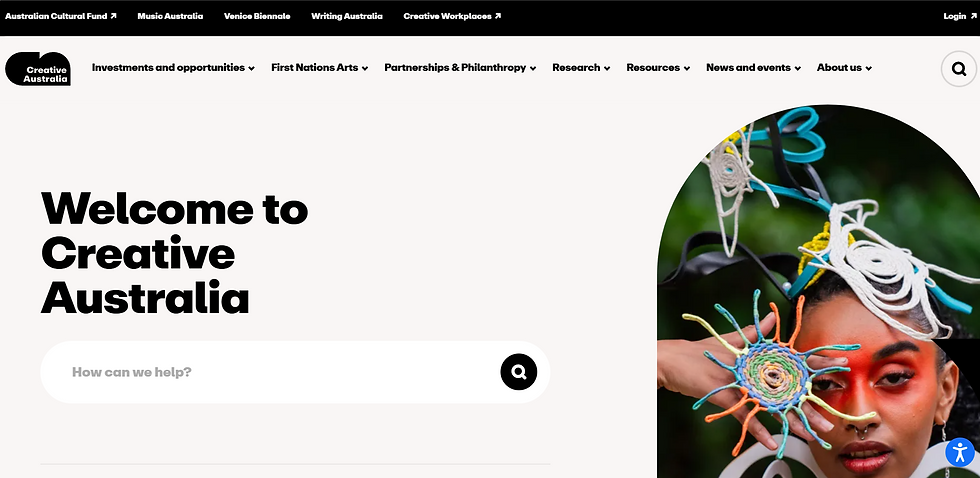
Creative Australia operates as Australia's national arts funding and advisory body, supporting artists, organisations, and cultural development across diverse creative sectors. The platform demonstrates how contemporary artistic practice extends beyond making artwork, requiring artists to engage with funding, project management, audience development, and community impact. Its strong emphasis on accessibility, diversity, First Nations representation, and interdisciplinary practice reflects changing priorities within the arts industry. The organisation positions art as both a cultural and social contribution rather than solely an individual pursuit.

Creative Plus Business – Funding F*#k Ups: 7 Mistakes to Avoid by Monica Davidson presents grant writing as a practical and strategic skill rather than an intimidating process. The article identifies common mistakes artists make, including vague project descriptions, unrealistic budgets, poor preparation, and failing to follow application guidelines. Its conversational tone makes funding processes feel more accessible while still reinforcing the professionalism required when applying for grants. The resource highlights that strong creative ideas alone are not enough.

Museums & Galleries of NSW operates as a key support and advocacy organisation for museums, galleries, and cultural institutions across New South Wales. The platform focuses on strengthening regional and metropolitan arts infrastructure through professional development, funding support, training, and sector-wide networking. A strong emphasis is placed on accessibility, community engagement, and sustaining cultural activity beyond major metropolitan centres. The organisation demonstrates how contemporary arts practice relies not only on artists, but also on collaborative institutional systems that support exhibition making, collections, education, and public programs.

Regional Arts NSW – Quick Response Grants provides targeted funding support for regional artists and arts workers seeking professional development opportunities that arise unexpectedly or within short timeframes. The program reflects an understanding that creative opportunities often emerge quickly and require flexible funding structures. Unlike larger grant programs with lengthy timelines, the Quick Response Grants prioritise accessibility, responsiveness, and immediate professional growth. The initiative also highlights the importance of supporting regional creative practitioners who may face geographic and financial barriers to national and international engagement.

Bundanon Residencies positions the residency as a space for concentrated research, experimentation, and creative development within a natural and culturally significant environment. The program supports artists, writers, researchers, and musicians by providing time away from everyday pressures, allowing sustained engagement with ideas and process. What distinguishes Bundanon is its emphasis on reflection, interdisciplinary exchange, and connection to landscape, history, and ecology. The residency demonstrates how creative practice can evolve through immersion and focused time rather than purely outcome-driven production.

ISCP Residency Programs operated by the International Studio & Curatorial Program provides international artists and curators with studio space, professional development, and access to New York’s contemporary art network. The residency emphasises cultural exchange, interdisciplinary dialogue, and critical engagement rather than isolated studio production. Through studio visits, public programs, and networking opportunities, ISCP positions residency programs as collaborative and research-driven environments that expand professional visibility and global connections. The organisation reflects the increasing internationalisation of contemporary art practice, where mobility, dialogue, and institutional engagement play significant roles in career development.

Skowhegan School of Painting & Sculpture is an intensive residency and educational program that supports emerging visual artists through experimentation, critical discussion, and interdisciplinary exchange. The program places strong emphasis on process, dialogue, and mentorship rather than commercial outcomes, creating an environment where artists can challenge and expand their practice. Its structure reflects the importance of peer networks and critical feedback within contemporary art education and professional development. Skowhegan also demonstrates how residencies function as spaces for long-term artistic growth rather than short-term production.
TOKAS Residency Program is a space for cultural exchange, experimentation, and international dialogue. The program supports artists, curators, and researchers through studio access, accommodation, and opportunities to engage with Tokyo’s contemporary art environment. A strong emphasis is placed on interdisciplinary interaction and cross-cultural collaboration, reflecting the increasingly global nature of contemporary art practice. The residency demonstrates how temporary immersion within another cultural context can expand artistic perspectives and professional networks.
References:
Art Almanac 2026, Art Almanac website, viewed 1 April 2026, <https://www.art-almanac.com.au>. (Figure 2)
ArtsHub 2026, ArtsHub website, viewed 1 April 2026, <https://www.artshub.com.au>. (Figure 3)
Bundanon 2026, Residencies, viewed 1 April 2026, <https://www.bundanon.com.au/residencies>. (Figure 8)
Creative Australia 2025, Creative Australia, Creative Australia, viewed 1 April 2026, <https://creative.gov.au>. (Figure 4)
Davidson, M n.d., Funding F#k Ups – 7 Mistakes to Avoid*, Creative Plus Business, viewed 1 April 2026, <https://creativeplusbusiness.com/funding-grant-application-fk-ups>. (Figure 5)
International Studio & Curatorial Program 2026, Residency Programs, ISCP, viewed 1 April 2026, <https://iscp-nyc.org/residency-programs>. (Figure 9)
Museums & Galleries of NSW n.d., Museums & Galleries of NSW, Museums & Galleries of NSW, viewed 1 April 2026, <https://mgnsw.org.au>. (Figure 6)
Regional Arts NSW n.d., Quick Response Grants, Regional Arts NSW, viewed 1 April 2026, <https://regionalartsnsw.com.au/quick-response-grants>. (Figure 7)
Skowhegan School of Painting & Sculpture 2026, Skowhegan School of Painting & Sculpture, viewed 1 April 2026, <https://www.skowheganart.org>. (Figure 10)
Tate 2018, Why Study Art? | TateShots, YouTube video, viewed 1 April 2026, <https://youtu.be/vKjkx6PzajE?si=fxT92Hwd7YmtEuFC>. (Figure 1)
Tate 2025, Why study art?, Tate, viewed 1 April 2026, <https://www.tate.org.uk/art/talking-point/why-study-art>.
Tokyo Arts and Space 2019, About TOKAS Residency, Tokyo Arts and Space, viewed 1 April 2026, <https://www.tokyoartsandspace.jp/en/residence/about.html>.


