

T5 WORKSHOP WEEK 3
- Feb 28
- 2 min read
Updated: Apr 8
Task: Surreal Self-Portrait (Collaborative Drawing Exercise)
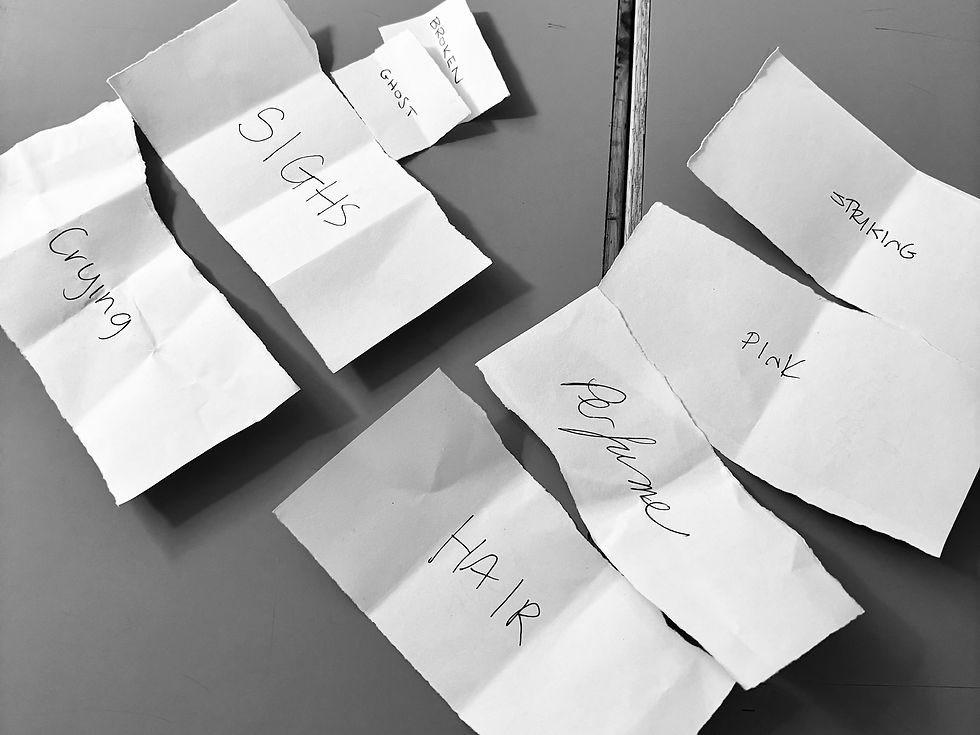
Working in a small group, create a collaborative surreal self-portrait. Begin by writing a noun, a verb, and an adjective and popping them into a box. Then all of us were to draw three of them out of the box. These words will act as the conceptual prompts.
Each member of the group is responsible for drawing one section or element of the portrait. The section they create should visually interpret one or more of the selected words, reflecting how they perceive those qualities within the subject.
The final image should combine all contributions into a single, unified but surreal composition, where identity is constructed through multiple perspectives rather than a single author.
This collaborative surreal self-portrait task functioned as both a conceptual and psychological challenge. Working with Den and Tracey, where Den constructed the upper section, I developed the central component, and Tracey completed the lower section, disrupted my usual controlled and self-directed approach to image-making. I tend to draw with a structured, deliberate logic, and I prefer to resolve ideas internally before committing them to paper. The immediacy of this exercise, combined with the unpredictability of shared authorship, destabilised that control. The random selection of words such as “broken,” “ghost,” “sighs,” “crying,” “striking,” “pink,” “perfume,” and “hair” required rapid conceptual translation. Due to my lived experience of neurological loss, I experience acute anxiety in situations demanding quick associative thinking. There is an immediate internal narrative of anticipated failure: that I will not process the prompt quickly enough or fully comprehend its meaning in visual terms. This cognitive pressure was present throughout the task.
As a result, my response became minimal and symbolic rather than elaborate. Instead of attempting expressive complexity, I reduced forms to just lines and shapes. What initially felt like inadequacy revealed itself as conceptual restraint. The fragmented composition, divided across three authors, inadvertently mirrored the instability suggested by the chosen words. Den's top section’s swirling, atmospheric gestures, my central transitional form, and Tracey's lower bodily fragment created a disjointed yet coherent psychological portrait.
Although I perceived my contribution as weak during production, the final image operates effectively as a conceptual portrait. It demonstrates how identity can be constructed through multiple perceptions rather than singular control. Importantly, the task exposed the tension between anxiety and experimentation in my practice. While uncomfortable, it forced a relinquishing of rigidity and introduced an element of play. Observing how Den and Tracey interpreted the same word prompts differently expanded my understanding of visual translation. Ultimately, the exercise revealed that constraint and discomfort can generate unexpected conceptual strength, even when the process feels destabilising.

Reference: (Figures 1-2) © Melanie Meggs
