T5 RESEARCH: Reham Samir, Illness Identity, and Life in Pieces
- Apr 19
- 3 min read

Reham Samir's analysis of Shahd Alshammari's Head Above Water is significant to my body of work, Life in Pieces, because it gives language to the way chronic illness destabilises identity. The discussion of "identity and the body" and "disability and identity" is particularly relevant to my own experience because it explains that identity is not fixed. It is shaped over time through the body, social relationships, memory, limitation, and the way others respond to illness. This connects directly to Life in Pieces, which does not present the self as whole or resolved, but as something interrupted, reconstructed, and constantly shifting.
The research explains that disability and illness can force identity formation to become a conscious action. This is important because illness changes how a person understands themselves and how they are understood by others. Before illness, the body can often be assumed as reliable or stable. With chronic illness, that assumption breaks down. Samir draws on theories that describe serious illness as a threat not only to the body, but also to the integrity of the self. This strongly reflects how I feel. My body no longer feels like a stable or obedient part of me. It can become something I have to negotiate with, manage, and work around. At times, it feels separate from who I am, even though it is also inseparable from me.
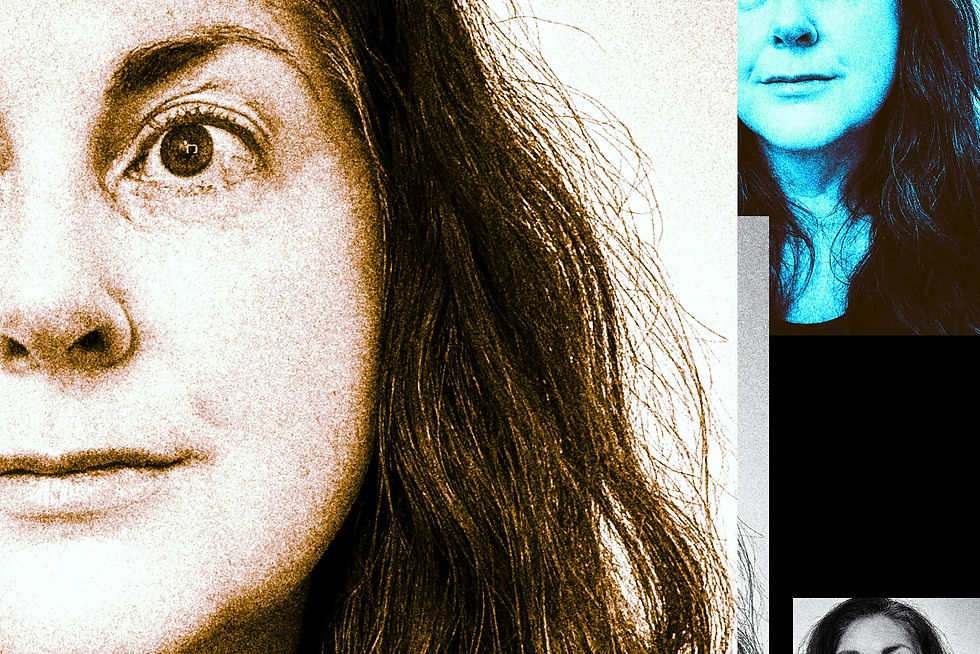
This tension between the body and the self is central to Life in Pieces. The resin head represents the instability of memory, cognition, and identity. The layered photographic image of my face is recognisable, but it is also distorted and misaligned. This reflects the way illness can make the self feel familiar and unfamiliar at the same time. I am still myself, but I am not the same version of myself that existed before neurological illness changed my body and mind. The work does not try to repair this fragmentation. Instead, it holds the fragmentation visibly.
Samir's discussion of Kathy Charmaz's illness identity model is also important because it explains chronic illness as intrusive. Intrusive illness is not temporary. It repeatedly interrupts daily life, plans, relationships, independence, and self-image. This directly connects to my experience of living with a body that requires constant attention. I have to think about fatigue, pain, balance, memory, heat, movement, and physical capacity in ways that other people may not see. This ongoing awareness changes how I move through the world and how I imagine my future. It also affects how I make art. My work has to respond to limitation, not as failure, but as part of the process.
The concrete pedestal in Life in Pieces speaks to this intrusive heaviness. It functions as a support structure, but it also carries the visual weight of pressure and limitation. The concrete holds the resin head, just as the body holds the self, but this support is not neutral. It is heavy, difficult, and physically demanding. Adding black oxide to darken the concrete made the material more personally connected to me, as black is the colour I wear most often and feel most myself in. This transformed the pedestal from a simple support into a bodily and emotional structure.
The video works also connect to Samir's research. Unsolvable reflects the difficulty of reconstructing memory and identity once something has been disrupted. The moving pieces never fully resolve, which mirrors the experience of trying to return to a former self that no longer exists in the same way. Frustration, positioned halfway down the installation to represent the hands, focuses on physical tension, anxiety, and the anger of not being able to control the body. Together, the videos show that illness affects both cognition and physical action.
Samir's research helps me understand Life in Pieces as an illness narrative. The work speaks to the grief of the former self, the instability of the present body, and the ongoing task of reconstructing identity through limitation. It also reflects the social pressure to appear normal, capable, and unchanged, even when the body is behaving unpredictably. Through resin, concrete, photography, and video, Life in Pieces becomes a way of making visible what is often hidden: the emotional, physical, and psychological labour of living inside an altered body.
References:
Samir, R 2025, Autopathography and identity in Head Above Water: reflections on illness by Shahd Alshammari, Humanities and Social Sciences Communications, vol. 12, article no. 1247, viewed 19April 2026, <https://pmc.ncbi.nlm.nih.gov/articles/PMC12326649>.